16 December 2025
Slip Disc Treatment: Surgery Isn't the Only Option
Diagnosed with a slipped disc? Don't panic. Learn about effective slip disc treatment options, from physiotherapy and injections to minimally invasive surgery.

A "slip disc" (herniated disc) diagnosis sounds terrifying. Patients often imagine their spine is falling apart or that surgery is the only path forward.
The reality is more reassuring: the majority of slip disc patients improve without ever needing an operation. This guide walks through the actual step-by-step treatment ladder we use in clinic, and where surgery genuinely fits in.
What Is a Slip Disc, Exactly?
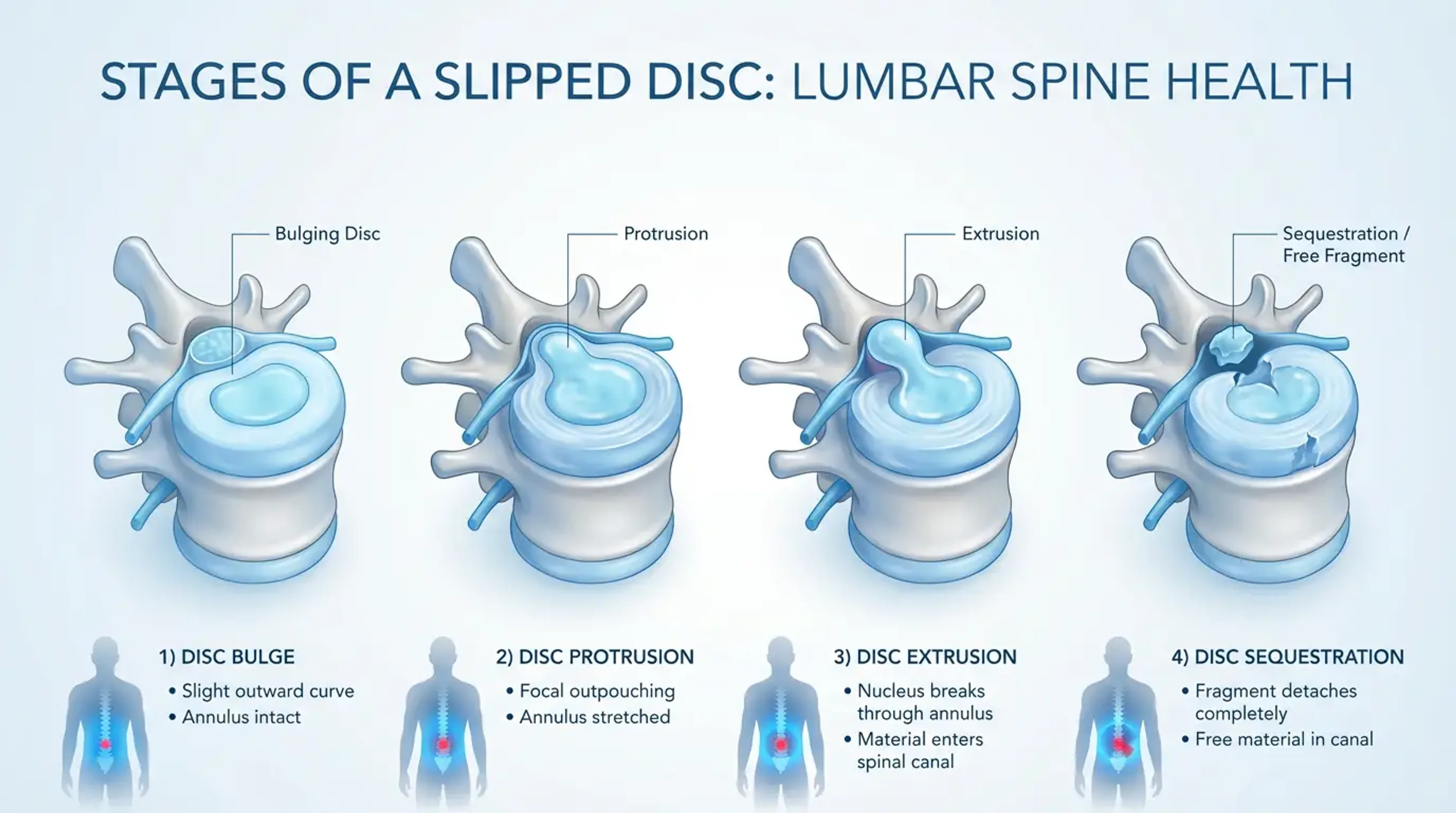
Think of a spinal disc as a jelly-filled cushion between two vertebrae. If the tough outer layer develops a tear, the softer inner material can bulge or leak out and press against a nearby nerve. Depending on where this happens, it causes localised back pain, pain radiating down a leg, or both — the leg-pain pattern is what's known as sciatica.
Herniated discs are often described in stages of severity — from a mild bulge to a fully extruded fragment — and understanding your specific stage (covered in our guide to slipped disc stages) helps set realistic expectations for treatment and recovery.
Step 1: Conservative Care (The First 6 Weeks)
Most disc herniations shrink and settle with time, since the body naturally reabsorbs some of the herniated material.
- Short rest, then movement: 2-3 days of relative rest is reasonable, but prolonged bed rest actually slows recovery and weakens supporting muscles.
- Medication: Anti-inflammatories and muscle relaxants help calm acute spasm and swelling around the nerve.
- Physiotherapy: Directional exercises (such as the McKenzie method) and traction techniques can help reduce pressure on the nerve and are often the single most effective non-surgical step.
Step 2: Targeted Injections
If pain hasn't meaningfully improved after 6 weeks of consistent conservative care, the next step is usually a joint injection — specifically an epidural steroid injection delivered around the affected nerve root.
This doesn't fix the disc itself, but it reduces inflammation around the pinched nerve enough that many patients can then participate fully in physiotherapy, which is often the missing piece that allows lasting recovery.
Step 3: Surgery (Reserved, Not First-Line)
Surgery becomes the right option only in specific situations:
- Pain remains severe and disabling despite a genuine trial of conservative care and injections
- New weakness develops in the foot or leg (foot drop)
- Loss of bladder or bowel control occurs — this is a surgical emergency, not something to schedule for later
For a broader framework on how this decision is made, see when back surgery is needed.
The procedure — Microdiscectomy: This is a minimally invasive operation that removes only the small fragment of disc pressing on the nerve, leaving the rest of the disc intact. Most patients walk the same day, and it is one of the procedures covered in our overview of minimally invasive spine surgery. Recovery timelines for this specific procedure are detailed in our guide to spine surgery recovery time.
What Determines Which Step You Need?
Not every patient moves through every step. The right starting point depends on:
- Severity and duration of pain
- Whether there is nerve-related weakness or numbness, not just pain
- MRI findings, correlated carefully with your actual symptoms
- How you respond to each stage of treatment — some patients improve quickly with physiotherapy alone, others need the full ladder
FAQs
Can a slip disc heal completely on its own? Many disc herniations shrink significantly over weeks to months as the body reabsorbs the displaced material, and symptoms often resolve even though the disc doesn't return to a perfectly normal shape on MRI. Consult your doctor to confirm this applies to your specific case rather than assuming it based on symptoms alone.
Is walking good or bad for a slip disc? Gentle walking is generally encouraged, as prolonged inactivity weakens the muscles that support the spine. Activities involving heavy bending, twisting, or lifting are usually restricted until the acute phase settles.
How do I know if my slip disc needs surgery? Surgery becomes a serious consideration if pain hasn't improved after a genuine trial of physiotherapy and injections, or if there's new weakness, foot drop, or loss of bladder/bowel control. A clinical exam combined with MRI findings determines this — not pain severity alone.
Is microdiscectomy a major surgery? It's considered minimally invasive — performed through a small incision, often as day care or an overnight stay, with most patients walking the same day. It is far less extensive than older open disc surgeries.
Takeaway
A slip disc is painful, but for most patients it is not a permanent or surgical problem. Start with structured conservative care, give it real time to work, and treat surgery as the option of last resort — reserved for cases where nerve damage or unrelenting pain make it genuinely necessary.
Diagnosed with a disc issue and unsure what stage you're at? Get a second opinion from Dr. Abhijit Kale to map out the right treatment path for your specific case.
Need Expert Orthopaedic Care?
Consult Dr. Abhijit Kale, Mumbai's trusted expert in Robotic Joint Replacement & Spine Surgery. Get a personalized treatment plan today.