16 December 2025
How Accurate Is Robotic Knee Replacement? Precision Explained
Precision matters in knee surgery. Learn how robotic knee replacement accuracy achieves sub-millimetre perfection and why this leads to better results for patients.

In carpentry, "measure twice, cut once" is a good rule. In knee replacement surgery, that rule is a matter of life-changing importance.
The success of a knee replacement depends heavily on alignment. Even a few degrees of error can cause the implant to feel unnatural, wear out faster, or cause pain.
This is where robotic knee replacement accuracy changes the game.
The Human Limit vs. Robotic Precision
Traditional knee replacement is performed using manual guides (jigs) and the surgeon's visual estimation.
- Manual Accuracy: Experienced surgeons are very good, but studies show outliers of 3 to 5 degrees are possible.
- Robotic Accuracy: Robotic systems consistently achieve alignment within 0.5 millimetres and 0.5 degrees of the plan.
This level of precision is virtually impossible to achieve consistently with the naked eye alone.
Why Does Accuracy Matter?
You might ask, "Is a few degrees really a big deal?" Yes.
1. Natural Feeling Knee
When the implant is positioned perfectly to match your unique anatomy, the ligaments retain their natural tension.
- Result: No "clunking" or stiffness. The knee feels more like your own.
2. Reduced Wear and Tear
If a car tyre is slightly misaligned, it wears out unevenly and fails early. The same applies to knee implants.
- Result: Perfect alignment distributes weight evenly, potentially extending the lifespan of the implant.
3. Less Soft Tissue Damage
Because the robot knows exactly where the bone is, there is no need to "explore" or pull on tissues unnecessarily to see the joint.
- Result: Less pain and swelling after surgery.
How Is This Accuracy Achieved?
Real-Time Mapping
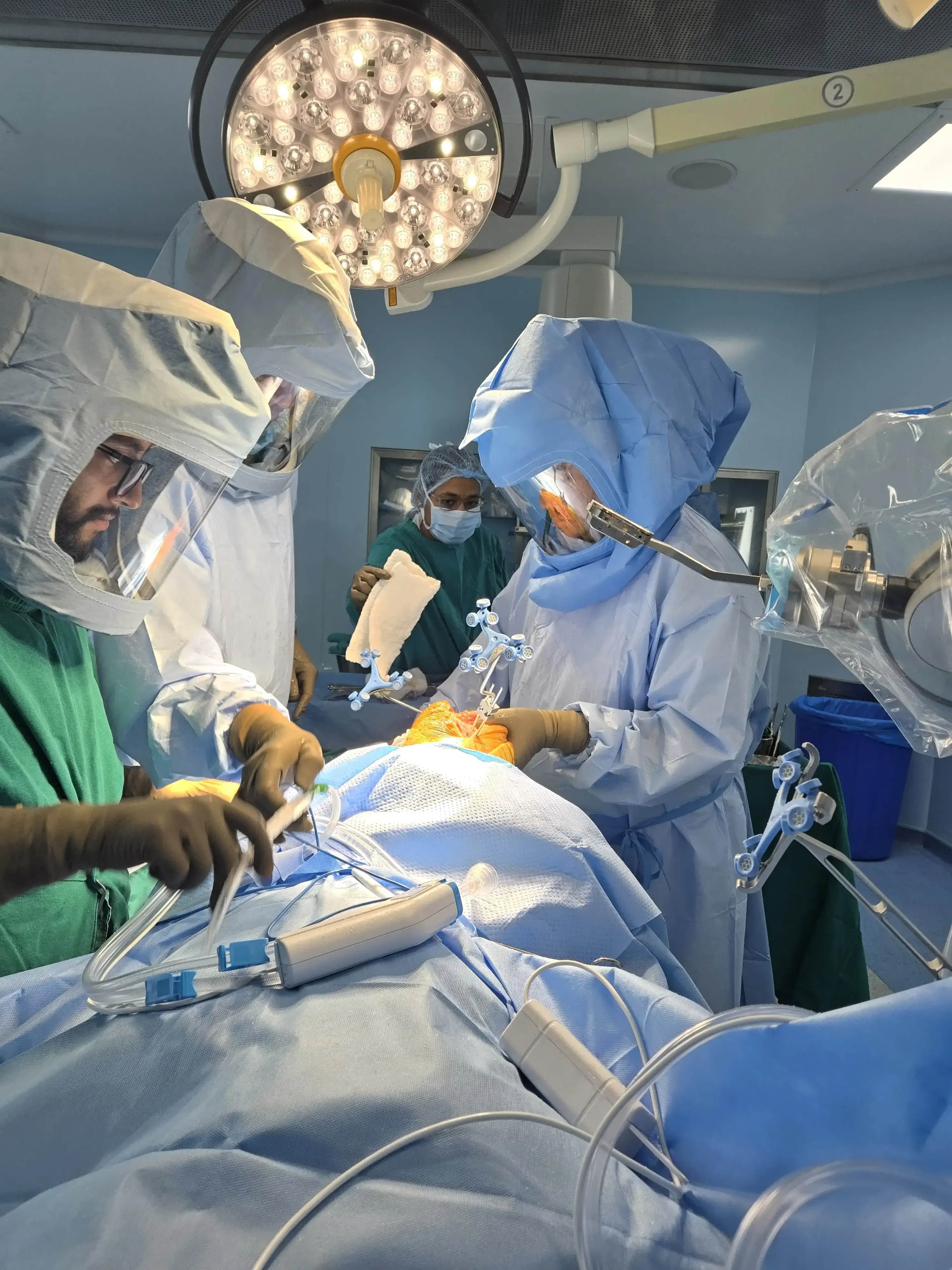
The robotic system (like the NAVIO or CORI) maps hundreds of data points on your knee surface. It creates a digital "twin" of your knee joint.
Dynamic Balancing
Before cutting bone, Dr. Abhijit Kale moves your leg through a range of motion. The computer calculates exactly how the ligaments stretch and relax, allowing the surgeon to adjust the implant position virtually to ensure perfect balance.
The "Burring" Action
Instead of using large oscillating saws that can vibrate, many robotic systems use a precision burr that sculpts the bone layer by layer, stopping instantly if it reaches the boundary.
Is It Accurate for Everyone?
Yes. Whether you have severe knock-knees (valgus), bow-legs (varus), or previous fractures, the robotic system adapts to your specific deformity.
In fact, the more complex the deformity, the more valuable robotic accuracy becomes.
Takeaway
Robotic accuracy transforms knee replacement from a "size matches most" procedure to a fully personalised, precision-engineered operation.
For patients, this means a straighter leg, a more natural walk, and a knee built to last.
Experience the precision of robotic surgery with Dr. Abhijit Kale in Mumbai. 👉 Book a Consultation
Need Expert Orthopaedic Care?
Consult Dr. Abhijit Kale, Mumbai's trusted expert in Robotic Joint Replacement & Spine Surgery. Get a personalized treatment plan today.


