16 December 2025
Knee Pain While Climbing Stairs: What It Means & How to Fix It
Does your knee hurt when going up or down stairs? Learn why stair climbing causes knee pain, the link to Runner's Knee and arthritis, and exercises to help.

Stair climbing is one of the most demanding everyday activities for your knees. The force passing through your kneecap (patella) when going up or down stairs can be several times your body weight, far more than what your knee experiences during flat-ground walking. This is exactly why stairs are often the first place people notice a knee problem, well before pain shows up during ordinary walking.
If you find yourself wincing or hesitating every time you see a flight of steps, here is what could be happening — and what tends to help.
Common Causes of Stair Pain
1. Chondromalacia Patella ("Runner's Knee")
This is the most common cause of stair-related pain in younger, active people. The cartilage on the underside of the kneecap softens and gradually wears down, which is aggravated specifically by the bent-knee, load-bearing position that stairs require. The typical symptom is a dull ache directly behind or around the kneecap, especially after sitting for long periods or after repeated stair use.
2. Osteoarthritis
In older adults, pain that appears specifically on stairs — before it appears anywhere else — is a classic early sign of arthritis. It often presents as a sharp catch or a grinding sensation with each step. This is one of the reasons stair pain overlaps closely with the early signs of knee arthritis that many patients report noticing first.
3. Patellar Tracking Disorder
Your kneecap is meant to glide smoothly within a groove at the end of the thigh bone. When muscle imbalances — particularly a weak inner quadriceps or tight outer structures — pull the kneecap slightly off track, it grinds against the bone with every bend, producing pain that is often worse on stairs than on flat ground.
4. Patellar Tendinitis
Repeated loading of the tendon just below the kneecap, common in people who have recently increased stair use, hill walking, or jumping activity, can cause localised tendon inflammation that is specifically aggravated by the bent-knee position stairs require.
Why Going Downstairs Often Hurts More
When you step down, your quadriceps muscle has to lengthen while still contracting to control your descent — this is called an eccentric contraction, and it places significantly more pressure on the kneecap joint than climbing up does. This is why many patients report that descending stairs, or walking downhill, is noticeably more painful than climbing.
How to Fix It
1. Strengthen the Inner Quadriceps (VMO)
The vastus medialis obliquus is the teardrop-shaped muscle on the inside of your thigh, just above the knee. Strengthening it helps pull the kneecap back into correct alignment within its groove.
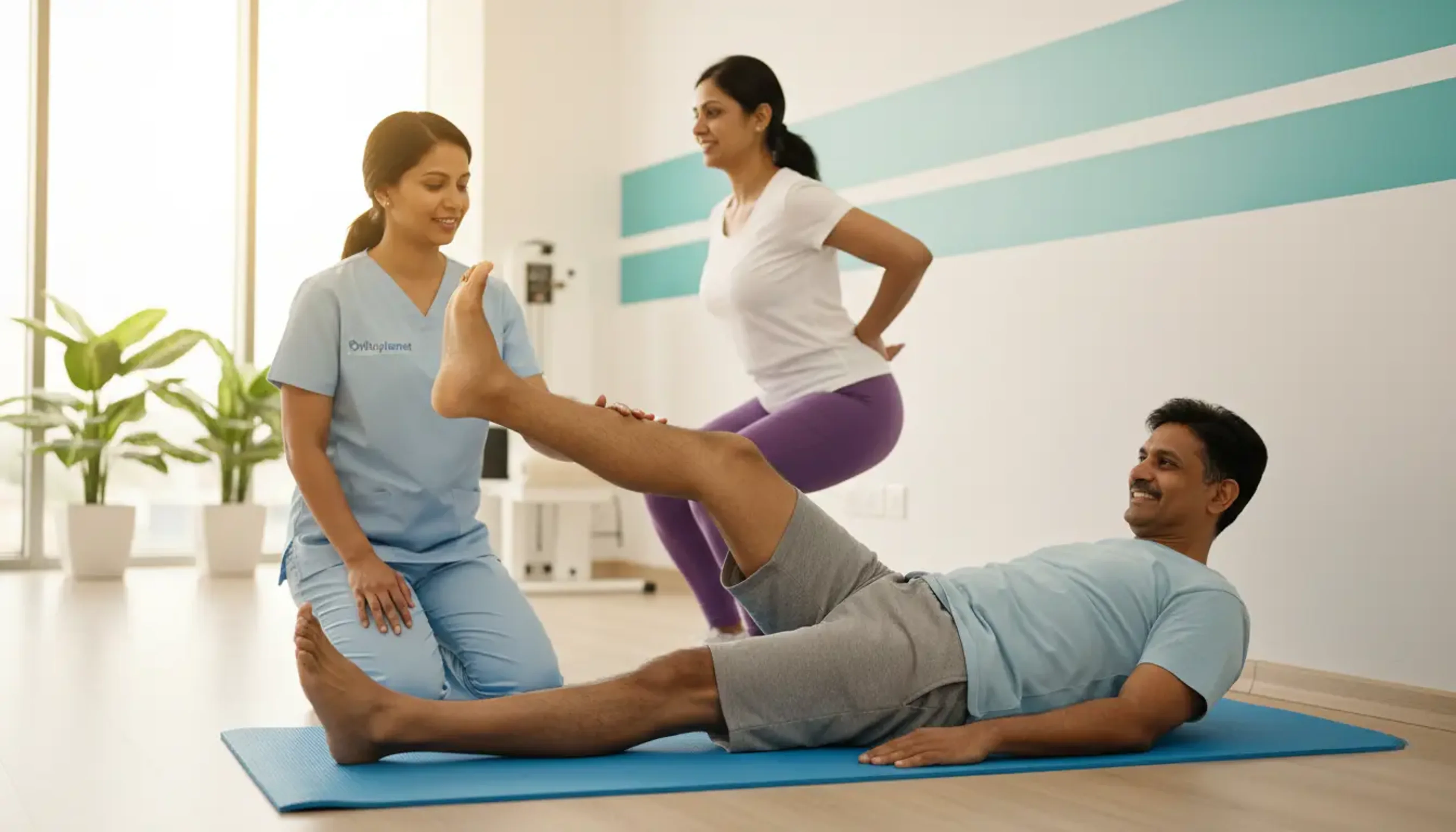
- Exercise: Straight leg raises with the toes turned slightly outward, done in controlled sets.
2. Strengthen the Glutes and Hips
Weak hip muscles allow the knee to collapse inward (a movement pattern called valgus) when stepping, which increases stress on the kneecap.
- Exercise: Clamshells and side-lying leg raises build hip stability that directly protects the knee.
3. Adjust Your Stair Technique
A simple rule can immediately reduce strain: good leg up, bad leg down.
- Going up: lead with your stronger, pain-free leg.
- Going down: lead with your weaker, painful leg, letting the stronger leg absorb more of the control.
4. Address Footwear and Surfaces
Worn-out or unsupportive shoes change how force travels up through the knee. Supportive, well-cushioned footwear can meaningfully reduce stair-related discomfort, particularly for people who are on their feet for much of the day.
For a broader, structured approach, our guide on exercises to strengthen knees and avoid surgery covers a fuller routine beyond stair-specific fixes.
When Stair Pain Needs a Professional Evaluation
Occasional mild discomfort that eases with rest is common and not usually a red flag. However, you should see a specialist if stair pain is:
- Getting worse over weeks rather than improving with rest and exercise
- Accompanied by swelling, clicking, or a sense of instability — see knee swelling causes
- Present even on flat ground or at rest, not just on stairs
- Limiting your ability to work, exercise, or manage daily activities
A physical examination combined with digital X-rays can usually confirm whether the cause is mechanical (tracking, tendinitis) or degenerative (arthritis).
FAQs
Is stair pain always a sign of arthritis? Not necessarily. In younger and more active people, chondromalacia patella and patellar tracking issues are far more common causes than arthritis. In people over 45, arthritis becomes a more likely explanation, especially if the pain has been gradually building over months.
Should I avoid stairs completely if they hurt? Complete avoidance isn't usually necessary or helpful long-term, since it can lead to further weakness. Modifying technique, using a handrail for support, and building strength through targeted exercises is generally more effective than total avoidance.
Can strengthening exercises really fix stair pain, or do I need surgery? Most cases of stair-related knee pain, especially in younger patients, improve significantly with targeted physiotherapy and strengthening. Surgery is typically reserved for advanced arthritis or structural problems that don't respond to conservative treatment.
How long does it take for exercises to reduce stair pain? With consistent effort, many patients notice some improvement within 4–6 weeks, though full benefit from a strengthening program often takes longer. Consistency matters more than intensity when it comes to these exercises.
Takeaway
Pain that shows up specifically on stairs is a meaningful early warning sign of mechanical stress or cartilage wear, and ignoring it often allows the underlying problem to progress. Strengthening the right muscles and adjusting technique helps many patients, but persistent or worsening pain deserves a proper evaluation.
Book an appointment with Dr. Abhijit Kale to get to the root of your stair pain.
Need Expert Orthopaedic Care?
Consult Dr. Abhijit Kale, Mumbai's trusted expert in Robotic Joint Replacement & Spine Surgery. Get a personalized treatment plan today.